One-Bite Rule: What It Means and Which States Still Use It
The one-bite rule makes a dog owner liable if they knew or should have known the dog was dangerous. What counts as knowing, the states that use it, the cases.
The one-bite rule makes a dog owner liable for a bite only if the owner knew, or should have known, that the dog was dangerous, or if the owner was careless in controlling it. In 13 states there is no dog bite statute at all, so this court-made rule decides every claim; in 16 more jurisdictions it still decides the cases their statute leaves out.
The name is misleading. A dog does not get a free first bite, and an owner can be liable for a first bite if the dog had growled, snapped or lunged at people before. Wyoming’s Supreme Court called the “one free bite” label “quite a misnomer” in 2003 3.
Where does the one-bite rule come from?
It is the old common-law rule of scienter, Latin for “knowingly”: the owner of a domestic animal answers for its harm without fault only once the owner knows of its dangerous tendency. American courts now state it in the words of the Restatement (Second) of Torts § 509. As the Kansas Court of Appeals quoted it in 2012, one who keeps a domestic animal “that one knows or has reason to know has dangerous propensities abnormal to its class is subject to liability … although one has exercised the utmost care” 4.
Several leading cases were not about dogs. Texas took its rule from Marshall v. Ranne (1974), a case about a boar hog 1. Alaska’s Hale v. O’Neill (1971) involved a horse 21. The rule covers domestic animals generally, and courts apply it to dogs without change.
The rule has two parts that work together. Once knowledge is proven, liability is usually strict: the owner pays even after taking every precaution. Without knowledge, the injured person can still sue for ordinary negligence, which asks whether the owner acted as a careful owner would.
Which states follow the one-bite rule?
These states have no civil dog bite statute. Each row links the state’s page, which cites the cases and gives the deadline to sue.
| State | How liability is decided |
|---|---|
| Alaska | No dog bite statute; owners are liable if they knew of a dangerous tendency (Hale v. O'Neill, 1971) or were negligent. |
| Arkansas | No dog bite statute; owner strictly liable only if they knew or should have known the dog was vicious, else negligence. |
| Hawaii | HRS § 663-9 (1980) removed the need to prove the owner knew the dog was dangerous; you must still prove negligence. |
| Kansas | No dog bite statute; owner liable if they knew of the dog's dangerous propensity or were negligent (Berry v. Kegans, 1966). |
| Mississippi | No dog bite statute; you must show the owner knew or should have known of the dog's dangerous propensity (Poy v. Grayson). |
| Nevada | No civil dog bite statute; owners answer in negligence. NRS 202.500 covers dangerous and vicious dogs only as a crime. |
| New Mexico | No dog bite statute; owner liable if they knew or should have known the dog was vicious, or under negligence. |
| North Dakota | No dog bite statute; Sendelbach v. Grad (1976): owner knew or should have known of danger and failed to use ordinary care. |
| South Dakota | No dog bite statute; owners are liable in negligence, and a known dangerous propensity proves it (Gehrts v. Batteen, 2001). |
| Texas | No civil dog bite statute; owner liable if they knew or should have known the dog was dangerous, or was negligent. |
| Vermont | No dog bite statute; the owner or keeper is liable only if they knew or had reason to know the dog was dangerous (Martin, 2014). |
| Virginia | No civil dog bite statute; owner liable if they knew of the dog's dangerous propensity or failed to use ordinary care. |
| Wyoming | No dog bite statute; owner liable if they knew of the dog's dangerous propensity or were negligent (Borns v. Voss, 2003). |
Two of them are one-bite states only in a loose sense. Hawaii’s HRS § 663-9 says an owner is liable regardless of “lack of scienter”, but the courts read it in 1986 and again in 2023 as removing the knowledge requirement while still requiring proof of negligence 14 15 31. Nevada has no knowledge rule written down either: in Wright v. Schum (1989) the Supreme Court decided a dog bite case entirely on negligence, weighing what the defendant “knew or should have known about the dog” 16. See Hawaii and Nevada.
The rule also survives in states with a partial statute. In New York the statute reaches only medical costs from a dog already declared dangerous, and the Court of Appeals’ Flanders v Goodfellow (April 17, 2025) keeps the knowledge rule for everything else while restoring a separate negligence claim 23. In Georgia, O.C.G.A. § 51-2-7 still requires a vicious or dangerous animal, but a local leash-law violation can prove it 24. Since 2014, Maryland presumes an owner knew, and the owner can try to rebut that 25. The strict liability guide lists every statute, and the national table shows all 51 jurisdictions side by side.
Strict once known, or negligence once known?
One-bite states split on what happens after knowledge is proven. Most make the owner liable without further proof of fault. A smaller group still asks whether the owner then used reasonable care.
Strict once known:
- Texas. Under Marshall, the owner’s care in confining a known dangerous animal is no defense 1.
- Arkansas. Strange v. Stovall (1977) rejected ordinary care as the standard for a known vicious dog; the owner keeps it “at his own risk” 10.
- Wyoming, Kansas, New Mexico and Alaska. Each follows the § 509 formula or its equivalent: liability once the owner knew or should have known, even if the owner used the utmost care 3 4 19 21. New Mexico writes it into its model jury instruction, UJI 13-506, re-approved in October 2025 20.
Knowledge plus failure of care:
- North Dakota. Sendelbach v. Grad (1976) requires that the owner knew or should have known the dog was dangerous and then failed to “exercise reasonable care” to prevent injury 13.
- South Dakota. An owner’s “failure to act upon the knowledge” of abnormally dangerous propensities is the breach of duty 6.
- Vermont. Martin v. Christman (2014) rejected strict liability. An owner who has reason to know the dog is a probable source of danger must restrain it, and failing to do so is negligence 11.
The difference matters when an owner with a known biter did take steps, such as a fence that failed. In Texas or Arkansas those steps do not defeat the claim. In North Dakota or Vermont a jury weighs them.
What counts as knowing the dog was dangerous?
A prior bite is the clearest proof, but courts in most of these states do not require one. The question is whether the dog had shown a tendency to hurt people that is abnormal for dogs, and whether the owner knew or should have known of it.
What courts have accepted:
- Growling and nipping. In Bradley v. Hendricks (1972), a dachshund’s growling at a parent and nipping at a child’s heels was enough for an Arkansas jury 9.
- Threat displays. South Dakota pointed to a dog the owner knew constantly barked, bared its teeth and strained at its leash. It rejected a literal free-bite rule in 1972: an earlier attack counts even if nobody was hurt 6.
- Growling, snapping or baring teeth. New York’s Court of Appeals lists these as ways to show the owner should have known, without any prior bite 23.
- Attacks on animals, sometimes. Vermont says known ferocity or attacks on other animals can be enough 11. New Mexico is split: the 2025 committee commentary to UJI 13-506 says aggression toward animals is not enough, while Smith v. Village of Ruidoso read a 1953 case the other way 20 19.
What courts have rejected:
- Barking. Barking is natural to dogs. A Mississippi visitor who broke her wrist backing away from a tied, barking dog lost in Ringo v. Wilson (2016) 8.
- A “watch dog” label. In Poy v. Grayson (1973), calling the dog a watch dog did not prove it had a vicious disposition 7.
- Breed alone. Vermont in 2018 and South Dakota in 2019 held that breed does not put anyone on notice, and South Dakota added that the bite itself does not prove the dog was dangerous 12 30.
- Knowledge of a different danger. In McCarthy v. Croker (1976), an owner who knew his dog chased and nipped at a neighbor’s horses did not know it would attack a person 26.
Timing matters too. The knowledge must exist before the bite. Kansas approved a jury instruction saying exactly that in Berry v. Kegans (1966) 5. Evidence of knowledge usually comes from neighbors, earlier complaints to animal control, a prior dangerous-dog finding, vet records, and what the owner said at the scene.
Do warning signs prove the owner knew?
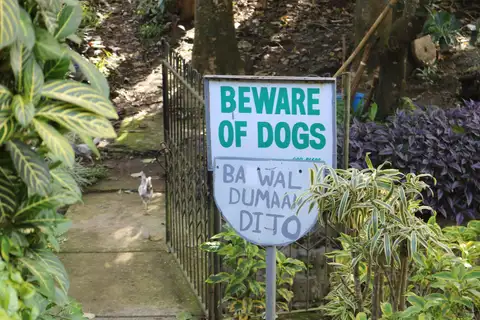
A “Beware of Dog” sign is evidence, but which way it cuts depends on the claim. In Hubbell v. Iseke (1986), a Hawaii negligence case, three “Beware of Dogs” signs along the driveway helped the owner win, because the jury asked whether the owner had acted reasonably 15.
None of the cases cited in this guide treats a sign as automatic proof of knowledge. A sign is one fact a jury can weigh with everything else about the dog. Some statutes give signs a specific effect; the state pages note where.
Negligence: liability without a known dangerous dog
An owner whose dog had a clean record can still be liable for careless handling. Wyoming overruled its older cases in 2003 and held that a bite can be negligence even if the dog had no dangerous propensity 3. In Bushnell v. Mott (2008), the Texas Supreme Court let a claim go to a jury against an owner who watched her dog attack a visitor and did nothing to stop it 2.
Leash and at-large ordinances are the most common route. Courts treat a violation in three ways:
- Negligence per se. A federal court in Sinclair v. Okata (1994) held that breaking Anchorage’s restraint ordinance was negligence per se 22. In Virginia’s Butler v. Frieden (1967), a child bitten by a loose dog won though the owners had no reason to think it would bite, because a Norfolk leash ordinance set the standard of care 17.
- Replacement for scienter, with limits. Wyoming’s Endresen v. Allen (1978) says a leash law eliminates the knowledge requirement, but the owner must have let the dog loose intentionally or negligently, and the violation must have caused the injury 27.
- Evidence only. Arkansas treats a broken city leash law as some evidence of negligence, not negligence per se 28.
The ordinance must fit the facts. In Stout v. Bartholomew (2001), Virginia’s Supreme Court held that a leash rule aimed at dogs taken off the owner’s land did not apply to a dog that escaped an electronic fence 18. Leash rules are local, so the wording of the city or county ordinance decides a lot.
How shared fault and defenses work
In a one-bite state, the injured person’s own conduct is handled by the state’s general fault rule. Most reduce the award by the injured person’s share of fault. Virginia is the hardest: under its contributory negligence rule, a plaintiff whose own carelessness was a proximate cause of the injury recovers nothing 29.
This table shows each state’s fault system.
| State | Rule | Statute or case |
|---|---|---|
| Alabama | Contributory negligence (any fault can bar recovery) | Williams v. Delta Int'l Machinery Corp., 619 So. 2d 1330 (Ala. 1993) |
| Alaska | Pure comparative fault | AS 09.17.060; AS 09.17.080 |
| Arizona | Pure comparative fault | A.R.S. § 12-2505 |
| Arkansas | Modified comparative fault (barred at 50%) | Ark. Code Ann. § 16-64-122 |
| California | Pure comparative fault | Li v. Yellow Cab Co., 13 Cal. 3d 804 (1975); Cal. Civ. Code § 1431.2 |
| Colorado | Modified comparative fault (barred at 50%) | C.R.S. § 13-21-111 |
| Connecticut | Modified comparative fault (barred at 51%) | Conn. Gen. Stat. § 52-572h |
| Delaware | Modified comparative fault (barred at 51%) | 10 Del. C. § 8132 |
| District of Columbia | Contributory negligence (any fault can bar recovery) | *Wingfield v. Peoples Drug Store, Inc.*, 379 A.2d 685 (D.C. 1977) |
| Florida | Modified comparative fault (barred at 51%) | Fla. Stat. § 768.81(6); § 767.04 |
| Georgia | Modified comparative fault (barred at 50%) | O.C.G.A. § 51-12-33 |
| Hawaii | Modified comparative fault (barred at 51%) | Haw. Rev. Stat. § 663-31 |
| Idaho | Modified comparative fault (barred at 50%) | Idaho Code § 6-801 |
| Illinois | Modified comparative fault (barred at 51%) | 735 ILCS 5/2-1116 |
| Indiana | Modified comparative fault (barred at 51%) | IC 34-51-2-5, -6 |
| Iowa | Modified comparative fault (barred at 51%) | Iowa Code § 668.3 |
| Kansas | Modified comparative fault (barred at 50%) | K.S.A. 60-258a |
| Kentucky | Pure comparative fault | Ky. Rev. Stat. § 411.182 |
| Louisiana | Modified comparative fault (barred at 51%) | La. Civ. Code art. 2323 |
| Maine | Modified comparative fault (barred at 50%) | 14 M.R.S. § 156; 7 M.R.S. § 3961(2) |
| Maryland | Contributory negligence (any fault can bar recovery) | Common law; *Coleman v. Soccer Ass'n of Columbia*, 432 Md. 679, 69 A.3d 1149 (2013) |
| Massachusetts | Modified comparative fault (barred at 51%) | Mass. Gen. Laws ch. 231, § 85 |
| Michigan | Other rule | MCL 600.2958, 600.2959 |
| Minnesota | Modified comparative fault (barred at 51%) | Minn. Stat. § 604.01 |
| Mississippi | Pure comparative fault | Miss. Code Ann. § 11-7-15 |
| Missouri | Pure comparative fault | RSMo § 273.036.1; Gustafson v. Benda, 661 S.W.2d 11 (Mo. banc 1983) |
| Montana | Modified comparative fault (barred at 51%) | Mont. Code Ann. § 27-1-702 |
| Nebraska | Modified comparative fault (barred at 50%) | Neb. Rev. Stat. § 25-21,185.09 |
| Nevada | Modified comparative fault (barred at 51%) | NRS 41.141 |
| New Hampshire | Modified comparative fault (barred at 51%) | N.H. Rev. Stat. Ann. § 507:7-d |
| New Jersey | Modified comparative fault (barred at 51%) | N.J.S.A. 2A:15-5.1 to -5.8 |
| New Mexico | Pure comparative fault | Scott v. Rizzo, 1981-NMSC-021, 96 N.M. 682, 634 P.2d 1234 |
| New York | Pure comparative fault | N.Y. CPLR 1411 |
| North Carolina | Contributory negligence (any fault can bar recovery) | N.C. Gen. Stat. § 1-139 (burden of proof); common law |
| North Dakota | Modified comparative fault (barred at 50%) | N.D.C.C. § 32-03.2-02 |
| Ohio | Modified comparative fault (barred at 51%) | Ohio Rev. Code § 2315.33 |
| Oklahoma | Modified comparative fault (barred at 51%) | 23 O.S. §§ 13–14 |
| Oregon | Modified comparative fault (barred at 51%) | ORS 31.600 |
| Pennsylvania | Modified comparative fault (barred at 51%) | 42 Pa.C.S. § 7102 |
| Rhode Island | Pure comparative fault | R.I. Gen. Laws § 9-20-4 |
| South Carolina | Modified comparative fault (barred at 51%) | Nelson v. Concrete Supply Co., 303 S.C. 243, 399 S.E.2d 783 (1991) |
| South Dakota | Other rule | SDCL 20-9-2 |
| Tennessee | Modified comparative fault (barred at 50%) | McIntyre v. Balentine, 833 S.W.2d 52 (Tenn. 1992) |
| Texas | Modified comparative fault (barred at 51%) | Tex. Civ. Prac. & Rem. Code §§ 33.001, 33.012 |
| Utah | Modified comparative fault (barred at 50%) | Utah Code §§ 78B-5-817 to -819 |
| Vermont | Modified comparative fault (barred at 51%) | 12 V.S.A. § 1036 |
| Virginia | Contributory negligence (any fault can bar recovery) | Common law; Williams v. Harrison, 255 Va. 272 (1998) |
| Washington | Pure comparative fault | RCW 4.22.005 |
| West Virginia | Modified comparative fault (barred at 51%) | W. Va. Code § 55-7-13c(c) |
| Wisconsin | Modified comparative fault (barred at 51%) | Wis. Stat. § 895.045(1) |
| Wyoming | Modified comparative fault (barred at 51%) | W.S. 1-1-109 |
Provocation, trespass and assumption of risk are argued as part of that fault analysis or as limits on the knowledge rule. In Texas, Marshall held that assumption of risk applies only if the person had a free choice 1. The provocation and trespass guide covers these defenses state by state.
What this means if you were bitten
In a one-bite state, the claim depends on evidence about the dog’s history and the owner’s conduct, gathered early:
- Identify the dog and owner. Get the owner’s name and address and the dog’s vaccination status, and report the bite. See what to do after a dog bite.
- Ask about past incidents. Neighbors, mail carriers and animal control records often know of earlier growling, lunging or bites.
- Check the local leash law. A loose dog in a leash-law area can support a negligence claim even with no history.
- Watch the deadline. The time limit runs regardless of the rule; see the statute of limitations guide.
The claim checker applies your state’s rule to the facts you enter. A landlord or property owner can sometimes be liable too, usually only with knowledge of the dog; see landlord liability.
What this means if your dog bit someone
After a first bite, the owner is on notice. A second bite of the same kind is far easier to prove, and in states like Texas, Arkansas and Wyoming the owner is then liable even after taking every precaution 1 10 3. A bite can also start a dangerous-dog case, and a prior dangerous-dog finding makes knowledge easy to prove, as Nevada’s page notes. See dangerous dog laws, my dog bit someone and dog bite insurance.
This guide is information, not legal advice. Each state page cites the cases it relies on and was reviewed in October 2026.
Questions
Does a dog really get one free bite?
No. The name is misleading. The question is what the owner knew or should have known before the bite, and a first bite can be enough for liability if the dog had already growled, snapped or nipped at people. Wyoming's Supreme Court called the "one free bite" label "quite a misnomer"3, and Arkansas let a jury decide a case where a dachshund had only growled and nipped at a child's heels before9.
Is Texas a one-bite state?
Yes. Texas has no civil dog bite statute. Under Marshall v. Ranne (1974) an owner who knew or should have known of a dangerous propensity is liable however careful they were, and otherwise the claim runs on negligence12. See the Texas page.
What happens after my dog bites someone for the first time?
The owner is now on notice. In a one-bite state, a second bite of the same kind is much easier to prove, and in states such as Texas, Arkansas and Wyoming liability for a known dangerous propensity applies even if the owner takes the utmost care1103. A first bite can also start a dangerous-dog case; see dangerous dog laws and my dog bit someone.
Can a dog's breed prove the owner knew it was dangerous?
Not on its own in the states that have decided it. Vermont held in 2018 that breed alone puts no one on notice12, and South Dakota held in 2019 that neither the breed nor the bite itself proves the dog was dangerous30.
Is Hawaii a strict liability state?
Not in practice. HRS § 663-9 removed the need to prove the owner knew the dog was dangerous, but the courts read it as still requiring proof of negligence141531. See the Hawaii page.
Sources
- Marshall v. Ranne, 511 S.W.2d 255 (Tex. 1974), CourtListener (Supreme Court of Texas opinion). Checked 17 October 2026.
- Bushnell v. Mott, 254 S.W.3d 451 (Tex. 2008), CourtListener (Supreme Court of Texas opinion). Checked 17 October 2026.
- Borns ex rel. Gannon v. Voss, 2003 WY 74, 70 P.3d 262, CourtListener (Wyoming Supreme Court opinion). Checked 17 October 2026.
- Carr v. Vannoster, No. 106,177 (Kan. Ct. App. Aug. 3, 2012) (published), Kansas Judicial Branch. Checked 17 October 2026.
- Berry v. Kegans, 196 Kan. 388, 411 P.2d 707 (1966), CourtListener (Kansas Supreme Court opinion). Checked 17 October 2026.
- Gehrts v. Batteen, 2001 S.D. 10, 620 N.W.2d 775, CourtListener (South Dakota Supreme Court opinion). Checked 17 October 2026.
- Poy v. Grayson, 273 So. 2d 491 (Miss. 1973), Caselaw Access Project (Harvard Law School). Checked 17 October 2026.
- Ringo v. Wilson, No. 2014-CA-01313-COA (Miss. Ct. App. Feb. 16, 2016), Mississippi Judiciary. Checked 17 October 2026.
- Bradley v. Hendricks, 251 Ark. 733, 474 S.W.2d 677 (1972), Caselaw Access Project (Harvard Law School). Checked 17 October 2026.
- Strange v. Stovall, 261 Ark. 53, 546 S.W.2d 421 (1977), Arkansas Judiciary. Checked 17 October 2026.
- Martin v. Christman, 2014 VT 55, Vermont Judiciary. Checked 17 October 2026.
- Gross v. Turner, 195 A.3d 654 (Vt. 2018), Caselaw Access Project (Harvard Law School). Checked 17 October 2026.
- Sendelbach v. Grad, 246 N.W.2d 496 (N.D. 1976), CourtListener (North Dakota Supreme Court opinion). Checked 17 October 2026.
- Hawaii Revised Statutes § 663-9 (Liability of owner or harborer of animal), Hawaii State Legislature. Checked 17 October 2026.
- Hubbell v. Iseke, 6 Haw. App. 485, 727 P.2d 1131 (1986), CourtListener (Hawaii Intermediate Court of Appeals opinion). Checked 17 October 2026.
- Wright v. Schum, 105 Nev. 611, 781 P.2d 1142 (1989), Animal Legal & Historical Center, Michigan State University College of Law. Checked 17 October 2026.
- Butler v. Frieden, 208 Va. 352, 158 S.E.2d 121 (1967), CourtListener (Supreme Court of Virginia opinion). Checked 17 October 2026.
- Stout v. Bartholomew, 261 Va. 547, 544 S.E.2d 653 (2001), CourtListener (Supreme Court of Virginia opinion). Checked 17 October 2026.
- Smith v. Village of Ruidoso, 1999-NMCA-151, 128 N.M. 470, 994 P.2d 50, New Mexico Compilation Commission. Checked 17 October 2026.
- UJI 13-506 NMRA, Liability of a dog owner (as amended Oct. 31, 2025), New Mexico Supreme Court. Checked 17 October 2026.
- Hale v. O'Neill, 492 P.2d 101 (Alaska 1971), CourtListener (Alaska Supreme Court opinion). Checked 17 October 2026.
- Sinclair v. Okata, 874 F. Supp. 1051 (D. Alaska 1994), CourtListener (U.S. District Court for the District of Alaska opinion). Checked 17 October 2026.
- Flanders v Goodfellow, 44 NY3d 57, 2025 NY Slip Op 02261 (Apr. 17, 2025), New York State Law Reporting Bureau. Checked 17 October 2026.
- O.C.G.A. § 51-2-7 (liability of owner or keeper of vicious or dangerous animal), Justia (Official Code of Georgia Annotated). Checked 17 October 2026.
- Md. Code, Courts and Judicial Proceedings § 3-1901, Maryland General Assembly. Checked 17 October 2026.
- McCarthy v. Croker, 549 P.2d 323 (Wyo. 1976), CourtListener (Wyoming Supreme Court opinion). Checked 17 October 2026.
- Endresen v. Allen, 574 P.2d 1219 (Wyo. 1978), CourtListener (Wyoming Supreme Court opinion). Checked 17 October 2026.
- Bolstad v. Pergeson, 305 Ark. 163, 806 S.W.2d 377 (1991), Caselaw Access Project (Harvard Law School). Checked 17 October 2026.
- Williams v. Harrison, 255 Va. 272 (1998), CourtListener (Supreme Court of Virginia opinion). Checked 17 October 2026.
- Ridley v. Sioux Empire Pit Bull Rescue, Inc., 2019 S.D. 48, 932 N.W.2d 576, South Dakota Unified Judicial System. Checked 17 October 2026.
- Franks v. Holloway, 153 Haw. 419, 540 P.3d 960 (App. 2023), CourtListener (Hawaii Intermediate Court of Appeals opinion). Checked 17 October 2026.