Dog Bite Levels: The Dunbar Bite Scale and What the Law Counts
The six dog bite levels of Dr. Ian Dunbar's scale, from a snap to a fatal attack, what the scale is not, and how state dangerous-dog laws measure injury instead.
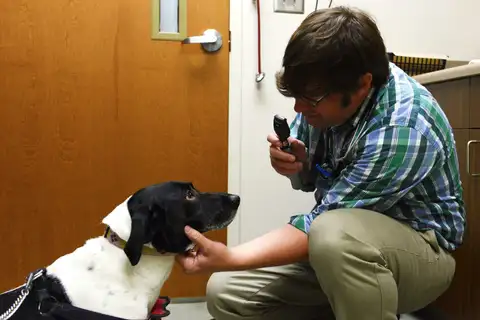
“Dog bite levels” almost always means the six-level Dunbar bite scale, written by veterinarian and trainer Dr. Ian Dunbar. It grades a bite by the wound it leaves, from Level 1 (a snap with no tooth contact) to Level 6 (the victim died) 1. It is a behavior tool for trainers, not a law: no state statute reviewed for this site uses its levels. Dangerous-dog statutes use their own terms, such as “severe injury” and “serious bodily injury,” and those terms decide hearings, euthanasia orders and criminal charges 3 6 7.
What are the six dog bite levels?
The official version, published by the Association of Professional Dog Trainers, calls itself “an assessment of the severity of biting problems based on an objective evaluation of wound pathology” 1. Each level describes what the teeth did to the skin.
| Level | What the scale describes 1 | Dunbar’s prognosis 1 |
|---|---|---|
| 1 | Obnoxious or aggressive behavior, but no skin contact by teeth | “Wonderful”: basic training |
| 2 | Teeth touch skin, no puncture; possible nicks under 1/10 inch deep and slight bleeding from teeth moving forward or sideways | “Wonderful”: basic training |
| 3 | One to four punctures from a single bite, none deeper than half the length of the dog’s canine teeth; possible lacerations in one direction (the victim or owner pulled away) | Fair to good, if the owner complies |
| 4 | One to four punctures from a single bite, at least one deeper than half the canine length; possible deep bruising (the dog held on) or lacerations in both directions (it shook its head) | Poor: “very dangerous” |
| 5 | A multiple-bite incident with at least two Level 4 bites, or several attacks with at least one Level 4 bite in each | Dunbar recommends euthanasia |
| 6 | Victim dead | Dunbar recommends euthanasia |
The key line is between Levels 2 and 3. Below it, the dog put its teeth on a person but held back. From Level 3 up, the teeth went in. Dunbar’s scale treats depth as the measure of the dog’s “bite inhibition,” its learned control over jaw pressure 1.
What the scale is and what it is not
The scale is a trainer’s triage tool. Its second half is advice to dog professionals: who can safely take on a case, how to manage a Level 4 dog at home, and when Dunbar himself recommends euthanasia 1. It says Levels 1 and 2 “comprise well over 99% of dog incidents” 1. That figure is his statement; the scale cites no data for it.
The scale is not:
- A medical grading. Doctors treat the wound in front of them. A Level 2 scratch can still become infected, and a Level 3 bite to a child’s face can need surgery. CDC advises seeing a healthcare provider when a wound is serious or deep, becomes infected, the dog’s rabies vaccination is unknown, or your last tetanus shot was more than five years ago 8.
- A legal standard. The California, Pennsylvania and Texas dangerous-dog statutes do not mention it 3 6 7. A label like “Level 4” in a trainer’s report is evidence of what happened, not a finding.
- A single fixed text. Copies online differ. Some list “one to three” punctures for Level 3, add a Level 3.5, or define Level 6 as the death of an animal 2. The version quoted above is the one APDT labels “official authorized” 1.
How trainers and shelters use bite levels
Trainers and behavior consultants use the level to decide whether a dog can be helped and how. Dunbar’s text recommends handling, desensitization and bite-inhibition exercises for Levels 1 and 2, and warns that Level 4 dogs have “insufficient bite inhibition” 1. A shelter or rescue may record a level in a dog’s file, which can follow the dog to its next home.
Some public agencies use it too. Officers of the City of Calgary, Canada, rate every dog-bite complaint they investigate on a version of the scale that Dr. Dunbar and Calgary Animal Services modified in 2012 2. A 2019 study of those records counted 2,723 chases or bites on people from 2012 to 2017 2. Of the incidents analyzed, 51% were Level 1 or 2, 35% were Level 3 and 13.5% were Level 3.5 or higher 2. The authors noted this is far from Dunbar’s “over 99%” and concluded that many minor incidents are never reported 2.
The same study found where serious bites happen. Compared with public places, the odds of a medium- or high-severity bite were 8.17 times higher inside the home 2. Young children, youths and older adults were at higher risk of more serious bites than adults aged 20 to 59 2. For U.S. figures, see dog bite statistics.
Does the bite level matter legally?
Not by name, but the injury it describes matters at every step. There are three separate legal tracks after a bite, and each measures harm differently.
- The civil claim. Whether the owner is liable depends on the state’s rule: a strict liability statute, the one-bite rule or negligence. A Level 2 bite and a Level 4 bite create the same liability in a strict liability state. The level mostly affects damages: medical bills, scarring and lost work. The settlements guide explains how.
- The dangerous-dog case. Animal control, police or a court can classify the dog and impose conditions. Here the statute’s injury definition often sets which class the dog falls into.
- The criminal case. An owner can face charges, and the most serious charges usually require serious injury or death.
Earlier low-level incidents also matter. In a one-bite state, a prior snap or nip (Level 1 or 2) can be evidence that the owner knew the dog could bite. The one-bite rule guide covers what courts accept as notice.
How dangerous-dog statutes measure injury
Each state writes its own definitions. Three examples from state files on this site show how much they differ.
California has two classes in its Food and Agricultural Code, enacted in 1989 3. A dog that, unprovoked, bites a person causing “less than a severe injury” can be declared potentially dangerous after one bite 3. A dog that, unprovoked, inflicts severe injury on or kills a person can be declared vicious 3. Severe injury means muscle tears, disfiguring lacerations, multiple sutures, or corrective or cosmetic surgery 3. The hearing uses a preponderance-of-the-evidence standard 4. See California dangerous-dog law.
Pennsylvania decides dangerousness in a criminal summary case before a magisterial district judge, who must find the facts beyond a reasonable doubt 6. One ground is severe injury to a person without provocation, defined as broken bones or disfiguring lacerations requiring multiple sutures or cosmetic surgery 6. Another is an unprovoked attack on a person, which the listed grounds do not tie to any injury 6. Act 18 of 2023 rewrote who may file the complaint 6. See Pennsylvania dangerous-dog law.
Texas has one class. A dog is dangerous if it makes an unprovoked attack causing bodily injury, or acts in a way that makes a person reasonably believe it will attack, outside a secure enclosure 7. A separate procedure covers death or serious bodily injury, meaning severe bite wounds or tearing of muscle that would require hospitalization 7. See Texas dangerous-dog law.
Roughly, a Level 3 bite already meets California’s “potentially dangerous” bite ground and Texas’s bodily-injury test. A Level 4 or 5 bite may reach “severe” or “serious” injury. But the statutes look at the medical result (sutures, surgery, hospitalization, broken bones), not puncture depth. A deep bite to the hand and the same bite to a toddler’s face can land in different legal classes.
This table lists each state’s dangerous-dog statute, its classes and any insurance requirement, from the state files on this site.
| State | State law | Classes | Required insurance |
|---|---|---|---|
| Alabama | Ala. Code §§ 3-6A-1 to 3-6A-8 | dangerous dog | $100,000 |
| Alaska | Local ordinances only | vicious dog (AS 03.55.020), level one to level five animal (Anchorage), vicious animal (Dillingham) | None statewide |
| Arizona | A.R.S. §§ 11-1014, 11-1029; § 13-1208 | vicious animal, aggressive dog | None statewide |
| Arkansas | Local ordinances only | — | None statewide |
| California | Cal. Food & Agric. Code §§ 31601–31683 | potentially dangerous dog, vicious dog | None statewide |
| Colorado | C.R.S. § 18-9-204.5 | dangerous dog | None statewide |
| Connecticut | Conn. Gen. Stat. § 22-358 | biting or attacking dog, nuisance by reason of vicious disposition | None statewide |
| Delaware | 16 Del. C. §§ 3071F–3081F | dangerous dog, potentially dangerous dog, nondangerous dog | $100,000 |
| District of Columbia | D.C. Code §§ 8-1901 to 8-1908 | dangerous dog, potentially dangerous dog | None statewide |
| Florida | Fla. Stat. §§ 767.10–767.16 | dangerous dog | $100,000 |
| Georgia | O.C.G.A. §§ 4-8-20 to 4-8-33 | dangerous dog, vicious dog, classified dog | $50,000 |
| Hawaii | Haw. Rev. Stat. §§ 711-1140 to 711-1148 | dangerous dog | $50,000 |
| Idaho | Idaho Code §§ 25-2810 to 25-2812 | at-risk dog, dangerous dog | None statewide |
| Illinois | 510 ILCS 5/15 to 5/15.5, 5/26 | dangerous dog, vicious dog, potentially dangerous dog, reckless dog owner | None statewide |
| Indiana | Local ordinances only | — | None statewide |
| Iowa | Local ordinances only | — | None statewide |
| Kansas | Local ordinances only | — | None statewide |
| Kentucky | Ky. Rev. Stat. § 258.235 | vicious dog | None statewide |
| Louisiana | La. R.S. 14:102.12–14:102.18 | dangerous dog, vicious dog | None statewide |
| Maine | 7 M.R.S. § 3952-A | dangerous dog, nuisance dog | $100,000 |
| Maryland | Md. Code, Crim. Law § 10-619 | dangerous dog, potentially dangerous dog | None statewide |
| Massachusetts | Mass. Gen. Laws ch. 140, § 157 | dangerous dog, nuisance dog | $100,000 |
| Michigan | MCL 287.321–287.323 | dangerous animal | None statewide |
| Minnesota | Minn. Stat. §§ 347.50–347.565 | dangerous dog, potentially dangerous dog | $300,000 |
| Mississippi | Local ordinances only | — | None statewide |
| Missouri | RSMo § 578.024 | dangerous dog | None statewide |
| Montana | Mont. Code Ann. § 7-23-2109 | vicious dog | None statewide |
| Nebraska | Neb. Rev. Stat. §§ 54-617 to 54-624 | dangerous dog, potentially dangerous dog | None statewide |
| Nevada | NRS 202.500 | dangerous, vicious | None statewide |
| New Hampshire | N.H. Rev. Stat. Ann. § 466:31 | nuisance, menace, vicious | None statewide |
| New Jersey | N.J.S.A. 4:19-17 to -37 | vicious dog, potentially dangerous dog | None statewide |
| New Mexico | NMSA 1978, §§ 77-1A-1 to 77-1A-6 | dangerous dog, potentially dangerous dog | None statewide |
| New York | N.Y. Agric. & Mkts. Law §§ 108(24), 123 | dangerous dog | None statewide |
| North Carolina | N.C. Gen. Stat. §§ 67-4.1 to 67-4.5 | dangerous dog, potentially dangerous dog | None statewide |
| North Dakota | N.D.C.C. ch. 42-03 | public nuisance | None statewide |
| Ohio | Ohio Rev. Code §§ 955.22–955.24 | nuisance dog, dangerous dog, vicious dog | $100,000 |
| Oklahoma | 4 O.S. §§ 44–47 | potentially dangerous dog, dangerous dog | $50,000 |
| Oregon | ORS 609.035, 609.095, 609.098 and 609.990 | potentially dangerous dog, dangerous dog | None statewide |
| Pennsylvania | 3 P.S. §§ 459-502-A to 459-507-A | dangerous dog | $50,000 |
| Rhode Island | R.I. Gen. Laws ch. 4-13.1 | vicious dog | $100,000 |
| South Carolina | S.C. Code Ann. §§ 47-3-710 to 47-3-770 | dangerous animal | $50,000 |
| South Dakota | SDCL 40-34-13 to 40-34-15 | vicious dog, dangerous animal | None statewide |
| Tennessee | Tenn. Code Ann. § 44-17-120 | dog that attacks a human and causes death or serious bodily injury, potentially vicious dog, vicious dog | None statewide |
| Texas | Tex. Health & Safety Code §§ 822.041–822.047 | dangerous dog | $100,000 |
| Utah | Local ordinances only | vicious animal | None statewide |
| Vermont | 20 V.S.A. § 3546 | vicious domestic pet | None statewide |
| Virginia | Va. Code §§ 3.2-6540 to 3.2-6540.04; § 3.2-6540.1 (vicious dogs) | dangerous dog, vicious dog | $100,000 |
| Washington | RCW 16.08.070–.110 | potentially dangerous dog, dangerous dog | $250,000 |
| West Virginia | W. Va. Code § 19-20-20 | vicious, dangerous, in the habit of biting or attacking other persons | None statewide |
| Wisconsin | Local ordinances only | — | None statewide |
| Wyoming | W.S. 11-31-301 | animal attacking any person in a vicious manner, vicious dogs | None statewide |
When injury severity leads to euthanasia or charges
The worst outcomes are tied to the worst injuries, not to a scale level. In Texas, a court must order a dog destroyed if it killed a person and may order it for serious bodily injury, with listed exceptions such as a trespasser entering the dog’s enclosure 7. Since a 2021 amendment, any destruction order is stayed 10 days for appeal 7. In Pennsylvania, a judge orders a dog seized and destroyed when, through the owner’s intentional, reckless or negligent conduct, it attacks and causes severe injury or death 6. In California, a dog declared vicious may be destroyed if releasing it would be a significant threat to public safety 3.
Criminal law follows the same pattern. California Penal Code § 399 makes it a felony when an owner who knows a dog is dangerous lets it run loose or fails to use ordinary care and it kills a person; serious bodily injury can be a misdemeanor or felony 5. In Pennsylvania, a severe injury or death caused by the owner’s conduct is a first-degree misdemeanor 6. In Texas, an owner who with criminal negligence fails to secure a dog that makes an unprovoked attack off the owner’s property causing serious bodily injury commits a third-degree felony 7.
This table shows each state’s criminal rule for serious injury or death caused by a dog.
| State | Rule |
|---|---|
| Alabama | An owner whose previously declared dangerous dog causes serious physical injury or death commits a Class B felony; if the dog was not declared but the owner knew of its dangerous propensities and acted with reckless disregard, it is a Class C felony. |
| Alaska | Alaska has no crime specific to a dog attack. |
| Arizona | The owner of a dog with a known history of biting, or found vicious by a court, commits a class 5 felony if it bites or attacks a person while at large; deliberately causing a dog to inflict serious injury is a class 3 felony. |
| Arkansas | Arkansas has no crime written for dog attacks. |
| California | Under Penal Code § 399, an owner who knows a dog is dangerous and lets it run loose or fails to use ordinary care commits a felony if it kills a person, and a misdemeanor or felony if it causes serious bodily injury. |
| Colorado | Owning a dangerous dog that injures a person is a class 2 misdemeanor; serious bodily injury is a class 1 misdemeanor (a class 6 felony on a second offense); a death is a class 5 felony, punishable by one to three years and a fine of $1,000 to $100,000. |
| Connecticut | Failing to comply with a final restraint or disposal order is a class D misdemeanor (up to 30 days and a $250 fine). |
| Delaware | Under 11 Del. |
| District of Columbia | Violating the registration or confinement rules for a dangerous or potentially dangerous dog is a misdemeanor: up to $500 and 90 days for a first offense, up to $1,000 and 90 days after that. |
| Florida | If a dog already declared dangerous seriously injures or kills a person, the owner commits a second-degree felony (raised by the 2025 Pam Rock Act); an unprovoked bite by a declared dog is a first-degree misdemeanor. |
| Georgia | Most violations of the law are misdemeanors. |
| Hawaii | Negligent failure to control a dangerous dog is a misdemeanor when a bite injury results from breaking the owner rules or the dog injures a person. |
| Idaho | Owning a dog found dangerous or at risk without complying with the court's order is a misdemeanor. |
| Illinois | If a vicious dog kept outside its required enclosure, or not spayed or neutered, makes an unprovoked attack that seriously injures or kills someone, the owner commits a Class 3 felony, or a Class 2 felony if the owner knowingly let it run at large. |
| Indiana | An owner who recklessly, knowingly or intentionally fails to restrain a dog that leaves the owner's property and bites someone without provocation commits a Class C misdemeanor. |
| Iowa | Iowa has no state crime for owning a dog that injures or kills someone. |
| Kansas | Permitting a dangerous animal to be at large, by an owner or custodian who knows of its vicious propensities, is a class B nonperson misdemeanor: up to six months in jail and a fine of up to $1,000. |
| Kentucky | Harboring a dog found to have attacked a person off the owner's premises carries a fine of $50 to $200, 10 to 60 days in jail, or both. |
| Louisiana | If a dog kills a person and the owner was reckless and criminally negligent in confining or restraining it, the owner commits negligent homicide, punishable by up to 10 years and a $5,000 fine. |
| Maine | Keeping a dog the court has declared dangerous or a nuisance is a civil violation with a $250 to $5,000 fine. |
| Maryland | Breaking the § 10-619 confinement, leash-and-muzzle or transfer-notice rules for a dangerous dog is a misdemeanor with a fine of up to $2,500. |
| Massachusetts | Chapter 140 punishes failure to comply with a dangerous-dog or nuisance-dog order: up to $500 and 60 days in jail for a first offense, up to $1,000 or 90 days for a later one. |
| Michigan | If a dog that meets the dangerous-animal definition kills a person, the owner is guilty of involuntary manslaughter under MCL 750.321; a serious injury is a felony punishable by up to 4 years, a fine of at least $2,000, or 500 hours of community service. |
| Minnesota | Letting a dog run uncontrolled or failing to confine it, causing great or substantial bodily harm, is a misdemeanor, and a gross misdemeanor for a repeat with the same dog. |
| Mississippi | If a dog the owner knew to be mischievous kills a person who took reasonable precautions, and the owner willfully let it go at large or kept it without ordinary care, the owner is guilty of manslaughter under § 97-3-45. |
| Missouri | Keeping a dangerous dog (a dog that has bitten before and bites again) is a class B misdemeanor, a class A misdemeanor if the attack causes serious injury, a class E felony if both attacks caused serious injury, and a class D felony if a person dies. |
| Montana | Violating a county vicious-dog ordinance is a misdemeanor. |
| Nebraska | Breaking the dangerous-dog rules is a Class IV misdemeanor. |
| Nevada | Knowingly keeping a vicious dog more than 7 days after actual notice, or transferring it, is a misdemeanor. |
| New Hampshire | A vicious-dog offense is a violation, not a crime: a $400 civil forfeiture the first time and $1,000 for a second within 12 months, and the owner is liable for all of the victim's medical bills. |
| New Jersey | No New Jersey statute makes a serious or fatal dog attack a crime in itself. |
| New Mexico | If a dangerous or potentially dangerous dog causes serious injury to a person without provocation, the owner commits a third-degree felony; if it kills a person, a third-degree felony resulting in death. |
| New York | An owner whose dog bites through the owner's negligence faces a civil penalty of up to $400, or $1,500 for serious physical injury. |
| North Carolina | An owner of a dangerous dog that attacks a person and causes injuries needing more than $100 of medical treatment commits a Class 1 misdemeanor. |
| North Dakota | No North Dakota statute makes a dog attack a crime in itself. |
| Ohio | An owner who negligently fails to stop an unprovoked vicious dog act (killing or seriously injuring a person) commits a third-degree misdemeanor on a first offense, even if the dog had no history; if the dog was already designated dangerous or vicious, it is a third-degree felony. |
| Oklahoma | If a dangerous dog, or a dog that has already bitten or threatened a person, kills someone, the owner commits a Class D1 felony, with prison of up to five years and a fine of up to $25,000. |
| Oregon | Maintaining a dangerous dog (failing, with criminal negligence, to prevent a serious injury or death) is a Class A misdemeanor, up to 364 days and $6,250. |
| Pennsylvania | If a dog aggressively attacks and causes severe injury or death to a person through the owner's intentional, reckless or negligent conduct, the owner commits a first-degree misdemeanor, punishable by up to five years in prison. |
| Rhode Island | Chapter 4-13.1 punishes owners with fines rather than jail: $1,000 when a declared vicious dog attacks or injures a person, $1,000 for each later attack, and $550 for keeping one without the required insurance, enclosure or identification. |
| South Carolina | The owner of a dangerous animal that makes an unprovoked attack injuring a person off its confinement commits a misdemeanor punishable by up to $5,000 or three years for a first offense; a second or later offense is a felony with up to $10,000 or five years. |
| South Dakota | No South Dakota statute makes it a specific crime when a dog injures or kills a person. |
| Tennessee | If a dog running at large causes serious bodily injury, the owner commits a Class E felony; if it causes death, a Class D felony. |
| Texas | If an owner with criminal negligence fails to secure a dog and it makes an unprovoked attack off the owner's property that causes serious bodily injury, the owner commits a third-degree felony; a second-degree felony if the victim dies. |
| Utah | Under Utah Code § 76-13-212, the owner of a vicious animal who knows its propensities and lets it run at large, or keeps it without ordinary care, commits a class B misdemeanor if it injures a person or animal, and a third-degree felony if it kills a person. |
| Vermont | Vermont has no crime specific to dog attacks. |
| Virginia | An owner whose willful act or omission in controlling a dog is so gross, wanton and culpable as to show reckless disregard for human life, and which causes an attack that seriously injures a person, commits a Class 6 felony. |
| Washington | The owner of any dog that aggressively attacks and causes severe injury or death of a person commits a class C felony, if the state proves the owner knew or should have known the dog was potentially dangerous. |
| West Virginia | Knowingly owning, keeping or harboring a vicious or dangerous dog violates § 19-20-20. |
| Wisconsin | Chapter 174 sets civil forfeitures, not crimes: $50 to $2,500 when a dog injures a person, rising to $200 to $5,000 if the owner knew of an earlier injury. |
| Wyoming | Under the state dog statute the penalties are small: a fine of up to $50 ($100 on a repeat) for an animal that attacked a person, and up to $200 when the attack was vicious. |
More detail is in the guides on dog bite euthanasia laws, criminal charges and dangerous dog laws.
What to record after a bite
Whatever level a bite seems to be, a precise record helps the doctor, the animal control officer and any insurer. These steps follow what statutes and agencies ask for.
- Get medical care first. Wash the wound with soap and water and see a doctor when CDC’s criteria apply 8. The medical record is the strongest evidence of severity.
- Photograph the wound. Take pictures the same day and over the following days, with a ruler or coin for scale. Count the punctures and note any tearing or bruising.
- Write down what the dog did. Note whether it bit once or several times, held on or shook, and what happened just before. Provocation and location matter under every statute above 3 6 7.
- Report the bite. Reporting duties vary by state; California requires a report of every bite to the local health officer 9. Your state page lists the rule.
- Keep every bill and record. They support any claim. Check the statute of limitations and the claim checker for your state.
If your own dog bit someone, my dog bit someone walks through the report, quarantine and any hearing. For first aid and rabies questions, see what to do after a dog bite. This page is general information, not legal advice.
Questions
Is a level 3 dog bite serious?
On the Dunbar scale, a Level 3 bite breaks the skin with one to four punctures, none deeper than half the length of the dog's canine teeth1. Any bite that breaks the skin can become infected, and CDC advises seeing a healthcare provider if the wound is deep or infected or the dog's rabies vaccination is unknown8. Legally, a single unprovoked bite causing less than severe injury is enough to start a potentially dangerous dog case in California3.
Will a dog be put down for a level 3 or level 4 bite?
Not because of the level. Dunbar's own text recommends euthanasia only for Levels 5 and 61, and that is a trainer's opinion. A court or agency can order a dog destroyed only under the state's statute and after its procedure. In Texas, a court may order it for serious bodily injury and must order it if the dog killed someone7. See the dog bite euthanasia guide.
Who decides what level a dog bite is?
No one officially, in most places. Trainers and behavior consultants assign levels when they assess a dog1, and some animal services agencies record them. The City of Calgary, Canada, has its officers rate every bite complaint on a modified Dunbar scale2. Courts and hearing officers apply the injury terms in their state's statute instead367.
Do I have to report a dog bite that did not break the skin?
It depends on the state. California requires every bite of a person to be reported to the local health officer9. Texas requires a report of any bite that could transmit rabies10. Your state page lists the reporting rule and the local office.
Sources
- Dr. Ian Dunbar's Dog Bite Scale (Official Authorized Version), Association of Professional Dog Trainers. Checked 1 January 2017.
- Caffrey N, Rock M, Schmidtz O, Anderson D, Parkinson M, Checkley SL. Insights about the Epidemiology of Dog Bites in a Canadian City Using a Dog Aggression Scale and Administrative Data. Animals (Basel) 2019;9(6):324, PubMed Central (National Library of Medicine). Checked 6 June 2019.
- California Food and Agricultural Code §§ 31601–31609 (definitions), California Legislature. Checked 17 October 2026.
- California Food and Agricultural Code §§ 31621–31626 (judicial process), California Legislature. Checked 17 October 2026.
- California Penal Code § 399, California Legislature. Checked 17 October 2026.
- Pennsylvania Dog Law, Act of Dec. 7, 1982, P.L. 784, No. 225 (3 P.S. § 459-101 et seq.), as amended through Act 47 of 2024, Pennsylvania General Assembly. Checked 17 October 2026.
- Texas Health and Safety Code ch. 822 (regulation of animals; dangerous dogs), Texas Legislature. Checked 17 October 2026.
- About Dogs and Your Health (Healthy Pets, Healthy People), Centers for Disease Control and Prevention. Checked 15 June 2026.
- Cal. Code Regs. tit. 17, § 2606 (Rabies, Animal), Legal Information Institute, Cornell Law School. Checked 17 October 2026.
- Texas Health and Safety Code ch. 826 (Rabies Control Act), Texas Legislature. Checked 17 October 2026.